Framework for Physical Perception of Photography
Framework for Physical Perception of Photography
Menu
Abstract
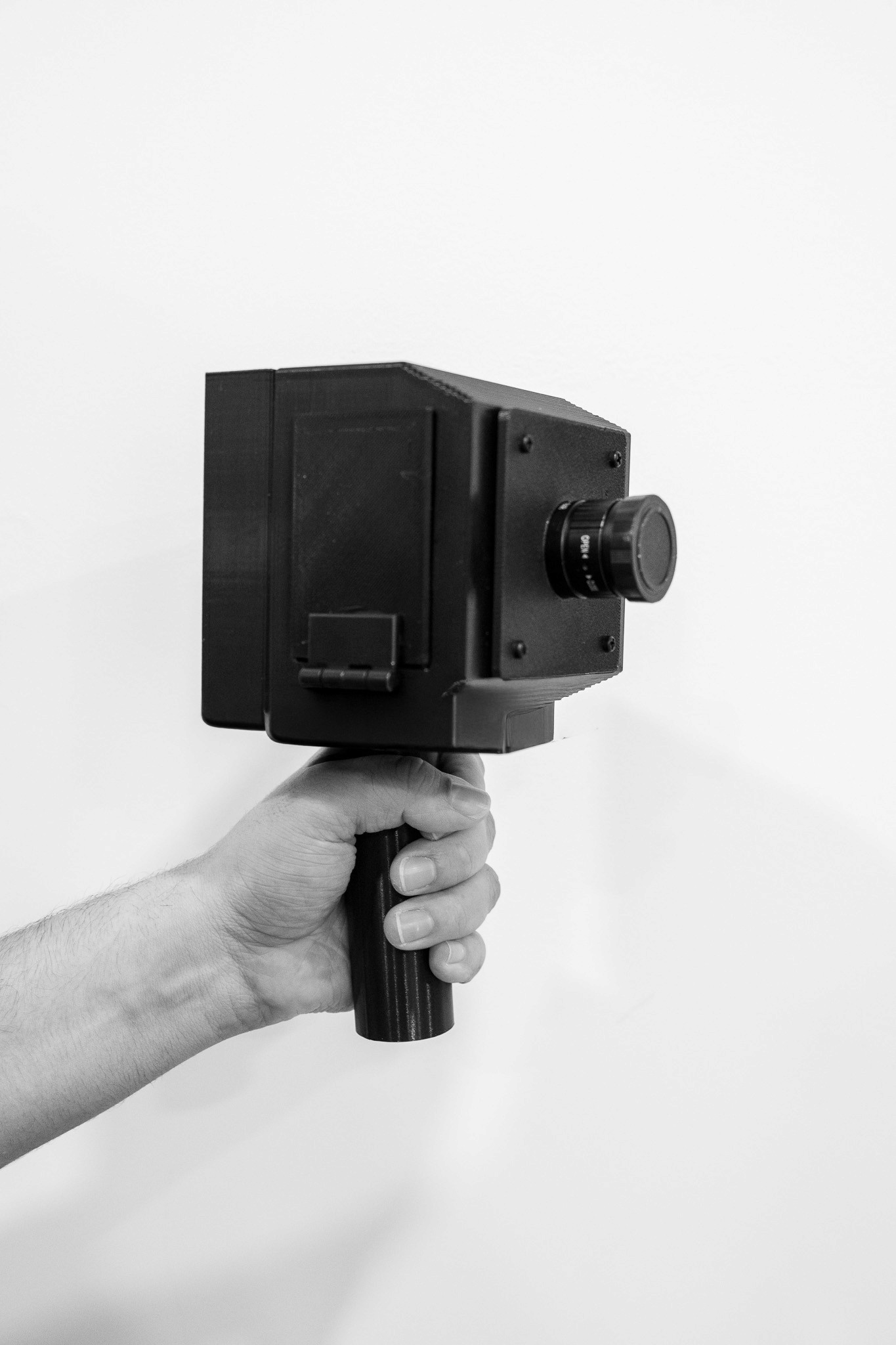
The Resonance Camera is a physical–computational imaging system that translates visual information and invisible environmental phenomena into a tactile spatial surface. Rather than functioning as a passive image-recording device, the camera operates as an active, embodied interface: a system that physically indexes light, time, and unseen forces through motion.
The project is being developed in clearly defined phases. Phase 1 (completed) establishes a functional imaging pipeline using an Arduino-compatible camera module with its native lens, paired with a distributed processing architecture. Image data captured by the Arduino system is transmitted to a Raspberry Pi 4, where custom Python scripts perform image processing, spatial transformation, and computational reinterpretation (including masking, object removal, and remapping).
Phase 2 (in progress) integrates environmental sensing—such as magnetometers and related field-sensing devices—whose data is synchronized with image frames and fused computationally. The combined data stream is then rendered physically through an updated solenoid-driven pin array, producing a tactile surface that simultaneously represents photographic imagery and normally imperceptible forces.
By merging embedded imaging, computation, sensing, and actuation, the 4D Experimental Camera reframes image-making as a tactile, temporal, and spatial experience—blurring the boundaries between camera, sculpture, and perceptual interface.
1. Motivation & Contribution
Traditional cameras collapse space and time into flat visual representations, prioritizing optical fidelity while distancing viewers from embodied engagement with light and environment. This project challenges that paradigm by reintroducing physicality into image formation—allowing images to be felt, not only seen.
Rather than relying on interchangeable lenses or photographic optimization, the system intentionally uses a fixed, embedded camera module. This constraint foregrounds computation, sensing, and actuation over optical refinement, aligning the camera more closely with measurement, translation, and interaction than with conventional representation.
Key Contributions
A phased physical–computational camera system, progressing from embedded image capture and Python-based transformation to multi-sensor environmental visualization
A distributed hardware architecture separating real-time acquisition from computational processing
A tactile imaging surface that physically renders both photographic content and non-visual environmental forces
Integration of Arduino-based acquisition, Raspberry Pi processing, Python computation, and solenoid actuation
An open, modular framework suitable for experimental imaging, artistic research, and tangible media systems
2. System Overview
Conceptual Pipeline
Functional Description
Image Capture (Phase 1 – Complete):
An Arduino-compatible camera module captures images through its native fixed lens. The Arduino handles camera triggering and low-level data acquisition.Processing & Transformation:
Image data is transmitted to a Raspberry Pi 4, where Python-based scripts perform computational image processing, including masking, object removal, spatial remapping, and data normalization.Sensor Integration (Phase 2 – In Progress):
Environmental sensors (e.g., magnetometers) connected to the Arduino collect real-time field data. Sensor readings are synchronized with image frames and transmitted to the Raspberry Pi for fusion.Physical Output:
The Raspberry Pi computes a combined image–sensor representation and generates actuation commands. These commands are sent back to the Arduino, which handles time-critical solenoid control, producing a tactile relief surface.
The result is a continuously evolving, touchable image that reflects both visible imagery and invisible environmental dynamics.
3. Technical Architecture
Key Components
Arduino-compatible camera module (native lens) — embedded image capture with fixed optics
Raspberry Pi 4 — primary processing unit running Python for image transformation, sensor fusion, and mapping
Magnetometer & environmental sensors — capture of non-visual forces such as magnetic fields
Solenoid-based pin array — discrete, fast vertical actuation forming a tactile image surface
Custom Python scripts — image editing, spatial remapping, sensor fusion, and actuation logic
3D-printed frame, guide plate, and pin carriers — mechanical alignment, modularity, and scalability
Arduino-compatible camera module (native lens) — embedded image capture with fixed optics, optimized for computational translation rather than optical variability
Raspberry Pi 4 (host computer) — primary processing unit running Python for image handling, data fusion, and actuator mapping
Magnetometer & environmental sensors — capture of non-visual forces (e.g., magnetic fields) synchronized with image data
Solenoid-based pin array — discrete, fast vertical actuation translating combined image and sensor data into tactile form
Custom Python scripts — image processing, masking, spatial remapping, sensor fusion, and solenoid control logic
3D-printed frame, guide plate, and pin carriers — mechanical alignment, modularity, and scalability of the pin-array system
4. Bill of Materials (BOM)
Component / System Quantity Est. Cost (USD)
--------------------------------------------- ---------- ---------------
Arduino Mega (or compatible) 1 $45
Raspberry Pi 4 (4GB) 1 $55
Arduino-compatible camera (native lens) 1 $30
Solenoid actuators (pin array) ~16 $100
Magnetometer + environmental sensors 1 set $25
MOSFETs / solenoid driver boards — $30
5–12V regulated power supply 1 $20
3D-printed frame & mechanical parts — $20
Wiring, connectors, fasteners — $25
Total Estimated Cost: ≈ $350
5. Research Context & Motivation
Theoretical Framework
Phenomenology of Perception (Merleau-Ponty): perception as embodied engagement rather than detached observation
Embodied Cognition (Varela et al.): meaning arises through sensorimotor interaction
Tangible Media (Ishii & Ullmer): computation expressed through physical form
Research Gap:
While imaging technologies increasingly pursue resolution and realism, few address how images might engage the body directly or reveal non-visual forces. This project treats imaging as a translation problem—mapping light and environmental data into physical experience.
6. Future Work
Higher-density pin arrays and smoother solenoid actuation
Expanded sensor fusion (electromagnetic fields, motion, proximity)
Time-based recording and replay of tactile images
Reduced latency through tighter acquisition–actuation coupling
Exhibition-scale and participatory installations
8. References
Varela, F. J., Thompson, E., & Rosch, E. (1991). The Embodied Mind. MIT Press.
Merleau-Ponty, M. (1962). Phenomenology of Perception. Routledge.
Ishii, H., & Ullmer, B. (1997). Tangible Bits. CHI’97.
Clark, A. (1997). Being There. MIT Press.
9. Citation
GitHub repository: https://github.com/CJD-11/Resonance-Camera
Abstract
The Resonance Camera is a physical–computational imaging system that translates visual information and invisible environmental phenomena into a tactile spatial surface. Rather than functioning as a passive image-recording device, the camera operates as an active, embodied interface: a system that physically indexes light, time, and unseen forces through motion.
The project is being developed in clearly defined phases. Phase 1 (completed) establishes a functional imaging pipeline using an Arduino-compatible camera module with its native lens, paired with a distributed processing architecture. Image data captured by the Arduino system is transmitted to a Raspberry Pi 4, where custom Python scripts perform image processing, spatial transformation, and computational reinterpretation (including masking, object removal, and remapping).
Phase 2 (in progress) integrates environmental sensing—such as magnetometers and related field-sensing devices—whose data is synchronized with image frames and fused computationally. The combined data stream is then rendered physically through an updated solenoid-driven pin array, producing a tactile surface that simultaneously represents photographic imagery and normally imperceptible forces.
By merging embedded imaging, computation, sensing, and actuation, the 4D Experimental Camera reframes image-making as a tactile, temporal, and spatial experience—blurring the boundaries between camera, sculpture, and perceptual interface.
1. Motivation & Contribution
Traditional cameras collapse space and time into flat visual representations, prioritizing optical fidelity while distancing viewers from embodied engagement with light and environment. This project challenges that paradigm by reintroducing physicality into image formation—allowing images to be felt, not only seen.
Rather than relying on interchangeable lenses or photographic optimization, the system intentionally uses a fixed, embedded camera module. This constraint foregrounds computation, sensing, and actuation over optical refinement, aligning the camera more closely with measurement, translation, and interaction than with conventional representation.
Key Contributions
A phased physical–computational camera system, progressing from embedded image capture and Python-based transformation to multi-sensor environmental visualization
A distributed hardware architecture separating real-time acquisition from computational processing
A tactile imaging surface that physically renders both photographic content and non-visual environmental forces
Integration of Arduino-based acquisition, Raspberry Pi processing, Python computation, and solenoid actuation
An open, modular framework suitable for experimental imaging, artistic research, and tangible media systems
2. System Overview
Conceptual Pipeline
Functional Description
Image Capture (Phase 1 – Complete):
An Arduino-compatible camera module captures images through its native fixed lens. The Arduino handles camera triggering and low-level data acquisition.Processing & Transformation:
Image data is transmitted to a Raspberry Pi 4, where Python-based scripts perform computational image processing, including masking, object removal, spatial remapping, and data normalization.Sensor Integration (Phase 2 – In Progress):
Environmental sensors (e.g., magnetometers) connected to the Arduino collect real-time field data. Sensor readings are synchronized with image frames and transmitted to the Raspberry Pi for fusion.Physical Output:
The Raspberry Pi computes a combined image–sensor representation and generates actuation commands. These commands are sent back to the Arduino, which handles time-critical solenoid control, producing a tactile relief surface.
The result is a continuously evolving, touchable image that reflects both visible imagery and invisible environmental dynamics.
3. Technical Architecture
Key Components
Arduino-compatible camera module (native lens) — embedded image capture with fixed optics
Raspberry Pi 4 — primary processing unit running Python for image transformation, sensor fusion, and mapping
Magnetometer & environmental sensors — capture of non-visual forces such as magnetic fields
Solenoid-based pin array — discrete, fast vertical actuation forming a tactile image surface
Custom Python scripts — image editing, spatial remapping, sensor fusion, and actuation logic
3D-printed frame, guide plate, and pin carriers — mechanical alignment, modularity, and scalability
Arduino-compatible camera module (native lens) — embedded image capture with fixed optics, optimized for computational translation rather than optical variability
Raspberry Pi 4 (host computer) — primary processing unit running Python for image handling, data fusion, and actuator mapping
Magnetometer & environmental sensors — capture of non-visual forces (e.g., magnetic fields) synchronized with image data
Solenoid-based pin array — discrete, fast vertical actuation translating combined image and sensor data into tactile form
Custom Python scripts — image processing, masking, spatial remapping, sensor fusion, and solenoid control logic
3D-printed frame, guide plate, and pin carriers — mechanical alignment, modularity, and scalability of the pin-array system
4. Bill of Materials (BOM)
Component / System Quantity Est. Cost (USD)
--------------------------------------------- ---------- ---------------
Arduino Mega (or compatible) 1 $45
Raspberry Pi 4 (4GB) 1 $55
Arduino-compatible camera (native lens) 1 $30
Solenoid actuators (pin array) ~16 $100
Magnetometer + environmental sensors 1 set $25
MOSFETs / solenoid driver boards — $30
5–12V regulated power supply 1 $20
3D-printed frame & mechanical parts — $20
Wiring, connectors, fasteners — $25
Total Estimated Cost: ≈ $350
5. Research Context & Motivation
Theoretical Framework
Phenomenology of Perception (Merleau-Ponty): perception as embodied engagement rather than detached observation
Embodied Cognition (Varela et al.): meaning arises through sensorimotor interaction
Tangible Media (Ishii & Ullmer): computation expressed through physical form
Research Gap:
While imaging technologies increasingly pursue resolution and realism, few address how images might engage the body directly or reveal non-visual forces. This project treats imaging as a translation problem—mapping light and environmental data into physical experience.
6. Future Work
Higher-density pin arrays and smoother solenoid actuation
Expanded sensor fusion (electromagnetic fields, motion, proximity)
Time-based recording and replay of tactile images
Reduced latency through tighter acquisition–actuation coupling
Exhibition-scale and participatory installations
8. References
Varela, F. J., Thompson, E., & Rosch, E. (1991). The Embodied Mind. MIT Press.
Merleau-Ponty, M. (1962). Phenomenology of Perception. Routledge.
Ishii, H., & Ullmer, B. (1997). Tangible Bits. CHI’97.
Clark, A. (1997). Being There. MIT Press.
9. Citation
GitHub repository: https://github.com/CJD-11/Resonance-Camera
Abstract
The 4D Experimental Camera is a physical–computational imaging system that translates visual information and invisible environmental phenomena into a tactile spatial surface. Rather than functioning as a passive image-recording device, the camera operates as an active, embodied interface: a system that physically indexes light, time, and unseen forces through motion.
The project is being developed in clearly defined phases. Phase 1 (completed) establishes a functional imaging pipeline using an Arduino-compatible camera module with its native lens, paired with a distributed processing architecture. Image data captured by the Arduino system is transmitted to a Raspberry Pi 4, where custom Python scripts perform image processing, spatial transformation, and computational reinterpretation (including masking, object removal, and remapping).
Phase 2 (in progress) integrates environmental sensing—such as magnetometers and related field-sensing devices—whose data is synchronized with image frames and fused computationally. The combined data stream is then rendered physically through an updated solenoid-driven pin array, producing a tactile surface that simultaneously represents photographic imagery and normally imperceptible forces.
By merging embedded imaging, computation, sensing, and actuation, the 4D Experimental Camera reframes image-making as a tactile, temporal, and spatial experience—blurring the boundaries between camera, sculpture, and perceptual interface.
1. Motivation & Contribution
Traditional cameras collapse space and time into flat visual representations, prioritizing optical fidelity while distancing viewers from embodied engagement with light and environment. This project challenges that paradigm by reintroducing physicality into image formation—allowing images to be felt, not only seen.
Rather than relying on interchangeable lenses or photographic optimization, the system intentionally uses a fixed, embedded camera module. This constraint foregrounds computation, sensing, and actuation over optical refinement, aligning the camera more closely with measurement, translation, and interaction than with conventional representation.
Key Contributions
A phased physical–computational camera system, progressing from embedded image capture and Python-based transformation to multi-sensor environmental visualization
A distributed hardware architecture separating real-time acquisition from computational processing
A tactile imaging surface that physically renders both photographic content and non-visual environmental forces
Integration of Arduino-based acquisition, Raspberry Pi processing, Python computation, and solenoid actuation
An open, modular framework suitable for experimental imaging, artistic research, and tangible media systems
2. System Overview
Conceptual Pipeline
Light + Environmental Forces
↓
Arduino Camera Module (native lens)
↓
Arduino (camera control & sensor acquisition)
↓
Raspberry Pi 4 (Python processing & sensor fusion)
↓
Mapping Algorithms
↓
Solenoid Drivers
↓
Dynamic Tactile Surface
Functional Description
Image Capture (Phase 1 – Complete):
An Arduino-compatible camera module captures images through its native fixed lens. The Arduino handles camera triggering and low-level data acquisition.Processing & Transformation:
Image data is transmitted to a Raspberry Pi 4, where Python-based scripts perform computational image processing, including masking, object removal, spatial remapping, and data normalization.Sensor Integration (Phase 2 – In Progress):
Environmental sensors (e.g., magnetometers) connected to the Arduino collect real-time field data. Sensor readings are synchronized with image frames and transmitted to the Raspberry Pi for fusion.Physical Output:
The Raspberry Pi computes a combined image–sensor representation and generates actuation commands. These commands are sent back to the Arduino, which handles time-critical solenoid control, producing a tactile relief surface.
The result is a continuously evolving, touchable image that reflects both visible imagery and invisible environmental dynamics.
3. Technical Architecture
┌────────────────────────────────────────────┐
│ IMAGING & SENSING FRONT END │
│ - Arduino-compatible camera (native lens) │
│ - Magnetometer & environmental sensors │
├────────────────────────────────────────────┤
│ ACQUISITION & CONTROL LAYER │
│ - Arduino microcontroller │
│ - Camera triggering │
│ - Sensor polling │
│ - Solenoid timing control │
├────────────────────────────────────────────┤
│ COMPUTATIONAL LAYER │
│ - Raspberry Pi 4 │
│ - Python image processing │
│ - Sensor fusion & spatial mapping │
│ - Actuation command generation │
├────────────────────────────────────────────┤
│ OUTPUT PIN ARRAY │
│ - Solenoid-driven pin grid │
│ - Precision guide plate & carrier │
│ - Modular, scalable design │
└────────────────────────────────────────────┘
Key Components
Arduino-compatible camera module (native lens) — embedded image capture with fixed optics
Raspberry Pi 4 — primary processing unit running Python for image transformation, sensor fusion, and mapping
Magnetometer & environmental sensors — capture of non-visual forces such as magnetic fields
Solenoid-based pin array — discrete, fast vertical actuation forming a tactile image surface
Custom Python scripts — image editing, spatial remapping, sensor fusion, and actuation logic
3D-printed frame, guide plate, and pin carriers — mechanical alignment, modularity, and scalability
Arduino-compatible camera module (native lens) — embedded image capture with fixed optics, optimized for computational translation rather than optical variability
Raspberry Pi 4 (host computer) — primary processing unit running Python for image handling, data fusion, and actuator mapping
Magnetometer & environmental sensors — capture of non-visual forces (e.g., magnetic fields) synchronized with image data
Solenoid-based pin array — discrete, fast vertical actuation translating combined image and sensor data into tactile form
Custom Python scripts — image processing, masking, spatial remapping, sensor fusion, and solenoid control logic
3D-printed frame, guide plate, and pin carriers — mechanical alignment, modularity, and scalability of the pin-array system
4. Bill of Materials (BOM)
Component / System Quantity Est. Cost (USD)
--------------------------------------------- ---------- ---------------
Arduino Mega (or compatible) 1 $45
Raspberry Pi 4 (4GB) 1 $55
Arduino-compatible camera (native lens) 1 $30
Solenoid actuators (pin array) ~16 $100
Magnetometer + environmental sensors 1 set $25
MOSFETs / solenoid driver boards — $30
5–12V regulated power supply 1 $20
3D-printed frame & mechanical parts — $20
Wiring, connectors, fasteners — $25
Total Estimated Cost: ≈ $350
5. Research Context & Motivation
Theoretical Framework
Phenomenology of Perception (Merleau-Ponty): perception as embodied engagement rather than detached observation
Embodied Cognition (Varela et al.): meaning arises through sensorimotor interaction
Tangible Media (Ishii & Ullmer): computation expressed through physical form
Research Gap:
While imaging technologies increasingly pursue resolution and realism, few address how images might engage the body directly or reveal non-visual forces. This project treats imaging as a translation problem—mapping light and environmental data into physical experience.
6. Future Work
Higher-density pin arrays and smoother solenoid actuation
Expanded sensor fusion (electromagnetic fields, motion, proximity)
Time-based recording and replay of tactile images
Reduced latency through tighter acquisition–actuation coupling
Exhibition-scale and participatory installations
8. References
Varela, F. J., Thompson, E., & Rosch, E. (1991). The Embodied Mind. MIT Press.
Merleau-Ponty, M. (1962). Phenomenology of Perception. Routledge.
Ishii, H., & Ullmer, B. (1997). Tangible Bits. CHI’97.
Clark, A. (1997). Being There. MIT Press.
9. Citation
Project page: https://www.coreydziadzio.com/altered-perception---4d-an-experimental-camera
GitHub repository: https://github.com/CJD-11/4D-Experimental-Camera
Menu